

Last updated: 29 October 2026. Based on UAE Ministry of Finance and FTA rules in force on this date. We update this page whenever the rules change.
The Short Version
E-invoicing has been in the news for months, and plenty of advice is going around: from accountants, from software sellers, from the WhatsApp group your supplier added you to. Some of it is right. Some of it is half right, which can be worse.
We talk to UAE business owners about this every week. These are the seven UAE e-invoicing myths we hear most, and what's actually true.
- Small business? Size only decides when you start, not whether you're included.
- Leaving it to your ASP? Your ASP delivers your invoices, but the responsibility stays with you.
- Waiting until June 2027? Your first deadline is 31 March 2027.
- Software vendor says it's ready? Check what "ready" actually means.
- Not VAT registered? Selling to other businesses decides it, not VAT.
- A new tax? No. VAT stays at 5%. Only how invoices travel changes.
- Must send at the moment of sale? You don’t have to send it on the spot. You get 14 business days, or the VAT Law deadline if you’re VAT registered.
Myth 1: "I'm a small business, so e-invoicing isn't for me."
Size only decides when you start, not whether you're included.
If you sell to other businesses or to government in the UAE, e-invoicing applies to you. A five-person trading company is covered just like a large distributor.
What changes with size is the date. Businesses with revenue under AED 50 million appoint their accredited service provider (ASP) by 31 March 2027 and start sending e-invoices on 1 July 2027. Larger businesses go six months earlier. The only ones left out for now are businesses that sell purely to consumers, plus a short list of activities such as international airline tickets.
To see how this works for six real business types, including free zone and non-VAT companies, read UAE E-Invoicing 2027: Is Your Business In or Out?
Myth 2: "My accountant or ASP will take care of it."
Your ASP delivers your invoices, but the responsibility stays with you.
It's easy to see why people think this. You appoint a provider, it sends everything to the FTA, so surely it's their job? Not quite. The Ministry of Finance guidelines are clear that the business issuing the invoice is still legally responsible for it.
The ASP checks the format and required fields. It may not catch a customer's outdated details or a wrong price, and those mistakes start in your own records.
Your accountant can guide you, but they don't create your invoices. Your sales team, drivers and office staff do, so they're the ones who need to be ready.
Myth 3: "I can wait until June 2027 to sort this out."
For businesses with revenue under AED 50 million, the first deadline is 31 March 2027, three months before go-live.
By 31 March, you need to have chosen an ASP, signed with them and appointed them on EmaraTax, the FTA's portal. Missing this step, or not having the system running by 1 July, can bring penalties.
Leaving it to the last few weeks also means competing with almost every other business in the UAE for the same providers and setup slots. That's why we suggest having your provider in place by mid-February.
Every date, with a month-by-month plan, is in UAE E-Invoicing 2027: Key Dates and How to Plan Ahead.
Myth 4: "My software vendor says it's ready, so I'm ready."
"E-invoicing ready" can mean very different things, so check what your software actually does.
For one vendor, it means a new invoice format. For another, it means a working connection to an approved provider. For some, it simply means "we're planning to."
Ask your vendor these questions and get the answers in writing:
- Can your system create e-invoices in the UAE format (PINT AE)?
- Is it connected to an ASP accredited by the Ministry of Finance? Which one?
- Can it receive e-invoices from my suppliers, not only send them?
- Does it handle credit notes, and the way I actually sell, such as van sales, progress invoicing or delivery notes?
- When will it be ready, and what will it cost?
If the answers are vague, or "ready" means sometime in mid-2027, take that as a warning. You'll want time to test before your deadline.
Myth 5: "I'm not VAT registered, so it doesn't apply to me."
VAT registration doesn't decide it. Selling to other businesses does.
This one catches a lot of small subcontractors and traders, because they assume anything tax-related isn't for them. But e-invoicing covers business-to-business sales whether or not you're VAT registered.
If you're below the VAT threshold, you issue commercial e-invoices, which are e-invoices without VAT. If you don't already have a tax ID number (TIN), you'll also need to register with the FTA for one, because your e-invoicing ID is based on it. After that, the dates and the ASP work the same way as for everyone else your size.
Myth 6: "E-invoicing is a new tax."
There's no new tax and no change to the VAT rate.
VAT stays at 5%, and the rules on what's taxable are the same. What changes is how your invoices travel: as structured data through an ASP, instead of as PDFs or paper.
The real difference is visibility. The FTA receives your invoice data as invoices are sent, not only when you file your VAT return. A mistake that might once have surfaced at audit time can now show up much sooner. That's a good reason to tidy your records, not a reason to expect a bigger tax bill.
Myth 7: "I have to send the e-invoice the moment I make the sale."
The general rule is 14 business days from the date of the transaction.
If you’re not VAT registered, you have 14 business days, under Ministerial Decision No. 197 of 2026 (in force from 1 October 2026). If you’re VAT registered, you follow the VAT Law deadline for tax invoices, generally 14 days from the date of supply. Either way, the clock starts on the day of the sale, or the day you’re paid if payment comes first. It’s good news for van sales and site teams: a driver with no signal doesn’t have to stop and send each invoice on the spot.
One word of caution, though. Having time to send the invoice doesn't mean you should create it later. Writing a paper note and typing it in days afterwards is where most invoice mistakes come from.
What These Myths Look Like in Real Life
On their own, these myths sound harmless. The trouble starts when they shape your decisions. Take a typical building materials trader in Sharjah, with about AED 12 million in revenue, selling mostly to contractors.
- He believes Myths 1 and 4: e-invoicing is for big companies, and his software vendor says "we'll be ready." So he waits. In late March, a large contractor says it needs proper e-invoices from 1 July to recover its VAT. He still has no provider, and the deadline is days away.
- Or he ignores the myths and starts in November. He cleans up customer TRNs, has a provider in place by mid-February and sends test invoices to two friendly contractors in April. On 1 July, invoices go out as usual.
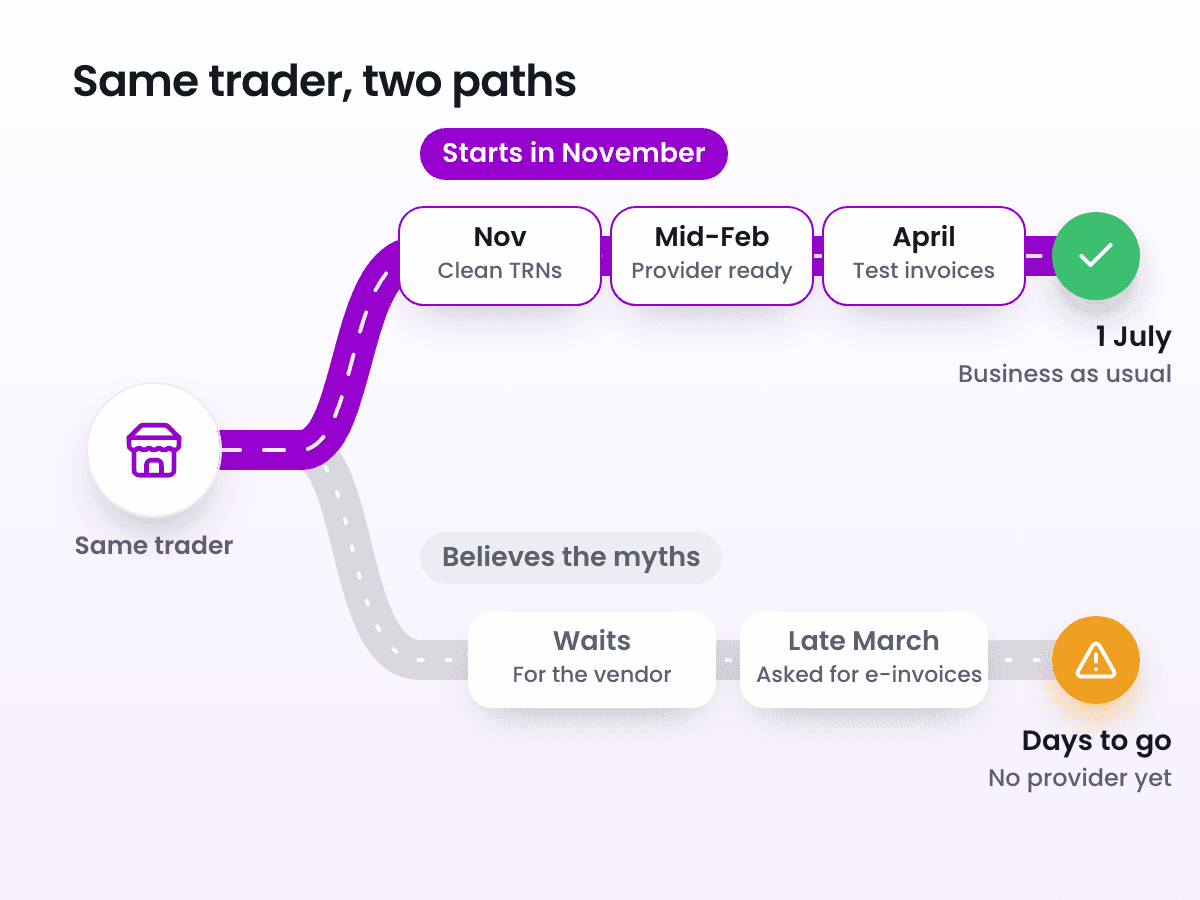
Same business, same rules. The only difference is which advice he believed.
What These UAE E-Invoicing Myths Have in Common
Look at the list again and you'll notice a pattern. Almost every myth leads to the same result: starting late. Either the business thinks the rule doesn't apply to it, thinks someone else is handling it, or thinks there's more time than there is.
The businesses that find this easy won't be the biggest ones. They'll be the ones that check their software, clean their records and pick a provider while there's still time to test.
If you'd rather not handle the provider and setup yourself, this is where we can help.
How Raad ERP Makes This Easier
Several of these myths come down to one worry: choosing a provider, connecting it and paying for it all feel like extra work. With Raad ERP, we handle most of that for you.
- Accredited ASP connection. We're connecting Raad ERP to an accredited ASP, so you won't need to compare providers or arrange a separate integration. Our team walks you through appointing it on EmaraTax.
- No separate ASP bill. ASP costs are included in your Raad ERP plan.
- Nothing to install. Raad ERP runs in the cloud, so you can start working without servers or setup on your own computers.
- We move your data for you. Our team cleans and imports your customers, TRNs and items from Excel, paper or your old software.
- Built for how you sell. Van sales, and delivery notes that turn into invoices in one click, are part of the system, so invoices are created where the sale happens.
A Few Quick Questions
Do invoices between my group companies count?
Can I use one ASP for sales and another for purchases?
Heard a Different Myth? WhatsApp Us
If someone has told you something about e-invoicing and you're not sure it's true, ask us. We'll tell you what the rules actually say and whether you need to do anything about it.
WhatsApp "MYTHS" to +971 54 543 7817 and we'll reply quickly.
Source: UAE Ministry of Finance: Ministerial Decisions No. 243 and 244 of 2025, No. 66 and 197 of 2026; UAE Electronic Invoicing Guidelines v1.1; FTA Public Clarification VATP046. mof.gov.ae/einvoicing
Raad ERP is built for UAE traders, manufacturers, van sales and contracting businesses. It covers invoicing, inventory, accounts and e-invoicing in one system.
This article is general information only and is not legal, tax or professional advice. Regulations, including ZATCA, UAE Ministry of Finance and FTA requirements, change often, and this content may be incomplete, out of date or contain errors. Before you act on it, check with the official authority (ZATCA in Saudi Arabia, or the Ministry of Finance or Federal Tax Authority in the UAE) or a qualified tax adviser. Raad ERP makes no warranties about the accuracy or completeness of this content and accepts no liability for any loss arising from reliance on it. Links to third-party websites are provided for convenience and are not endorsements.