

Last updated: 28 October 2026. Based on UAE Ministry of Finance and FTA rules in force on this date. We update this page whenever the rules change.
The Short Version
One of the first things business owners ask us is whether e-invoicing applies to them at all. Before you change anything in your business, it helps to know where you stand. This quick check will tell you.
Here's the short answer to who needs UAE e-invoicing: if your business sells to other businesses or to government in the UAE, it applies to you. Your size doesn't change that, and neither does your VAT status. Size only decides when you start.
- In: sales to other businesses (B2B) and to government (B2G).
- Out for now: sales to consumers and walk-in customers (B2C).
- VAT registration doesn't matter. Businesses that aren't VAT registered are included too.
- Revenue only decides your start date. Under AED 50 million, you go live on 1 July 2027.
New to e-invoicing? Start with our guide UAE E-Invoicing 2027 Made Simple: Rules & What Changes.
How Do I Know If It Applies to Me?
Answer these three questions. They take less than two minutes.
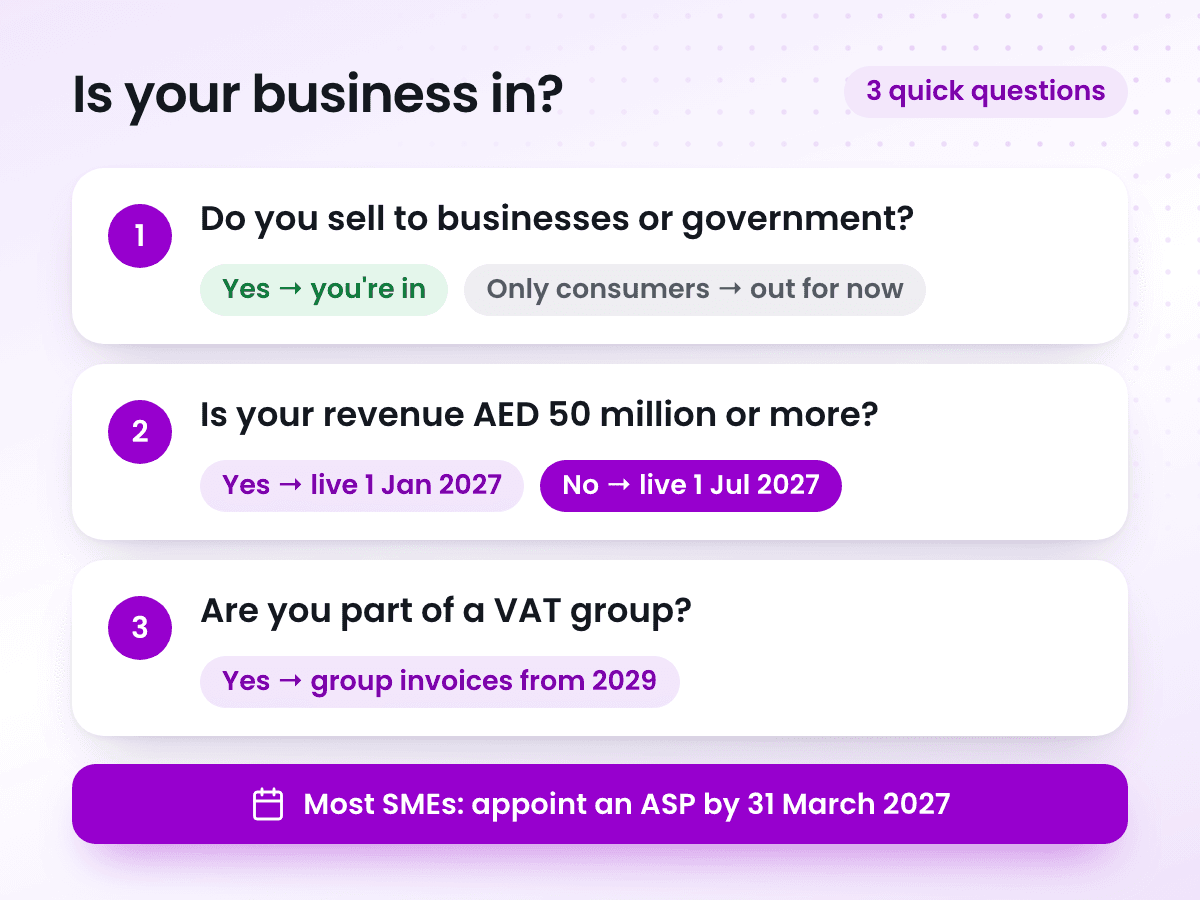
1. Do You Sell to Other Businesses or to Government in the UAE?
- Yes: e-invoicing applies to those sales. Go to question 2.
- No, only to consumers: you're out of scope for now. See business 4 below.
2. Is Your Annual Revenue AED 50 Million or More?
- Yes: appoint your accredited service provider (ASP) by 30 October 2026 and go live on 1 January 2027.
- No: appoint your ASP by 31 March 2027 and go live on 1 July 2027.
Revenue is based on your latest financial statements. If you don't have them, other documents the FTA accepts can be used.
3. Is Your Business Part of a VAT Group?
- Yes: a VAT group is two or more related companies registered for VAT as one, with a single TRN. Invoices between companies in the group don't need e-invoicing until 31 December 2028, but sales to anyone outside the group are still in. We explain this with an example in business 6 below.
- No: nothing changes, and your answers to questions 1 and 2 decide it.
Who Needs UAE E-Invoicing? 6 Businesses Checked
These six businesses cover the questions we hear most. Find the one closest to yours.
1. A Mainland Trader Selling to Other Businesses
Short answer: Yes, fully in.
A Sharjah foodstuff wholesaler sells rice, oil and sugar to other traders, catering companies and company canteens. Every one of those customers is a business, so every sale is B2B.
- Every sales invoice and credit note must be an e-invoice.
- Invoices from its own suppliers will arrive as e-invoices too, through its ASP.
- With revenue under AED 50 million, it goes live on 1 July 2027.
This is the most common case. If it sounds like your business, you're in.
2. A Free Zone Company Selling to Mainland Customers
Short answer: Yes, for the transactions the rule covers.
A trading company in a Sharjah free zone imports spare parts and sells them to garages across the UAE.
- Being in a free zone doesn't take you out of e-invoicing. There's no blanket free zone exemption.
- Its sales to UAE businesses are B2B, so they're in scope.
- Free zone deals can involve special VAT treatment, so your software and ASP need to handle those invoice details correctly.
Many free zone owners assume the rules don't reach them, but for e-invoicing, they do.
3. A Small Contractor Who Isn't VAT Registered
Short answer: Yes, even without VAT registration.
A small fit-out subcontractor earns below the VAT threshold and isn't VAT registered. It invoices main contractors for its work.
- E-invoicing covers businesses whether or not they're VAT registered.
- Because it can't issue VAT tax invoices, it issues commercial e-invoices instead. These are e-invoices without VAT.
- If it doesn't already have one, it must register with the FTA for a tax ID number (TIN), because its e-invoicing ID is based on it.
- It still needs an ASP, and it follows the same 1 July 2027 date.
This surprises a lot of small business owners. "No VAT" doesn't mean "no e-invoicing".
4. A Shop That Sells Only to Walk-In Customers
Short answer: Not for its sales, for now.
A small hardware shop in Ajman sells only over the counter to the public. It never invoices a company.
- Sales to consumers are excluded until the Ministry of Finance announces otherwise.
- A business that makes only consumer sales doesn't have to issue e-invoices.
- The moment it sells to a business, even occasionally, those sales are B2B and in scope.
- It still buys from suppliers, but it doesn't need an ASP for now. Its suppliers handle the e-invoicing on their side.
It's worth checking your sales mix. Many shops in the trading business also supply contractors, offices or other shops.
5. An Exporter Selling to Overseas Buyers
Short answer: Yes, with a special route.
A Dubai manufacturer sells packaging material to buyers in Oman and Saudi Arabia.
- Export sales are still in scope. Having an overseas buyer doesn't make them exempt.
- If the buyer isn't on the Peppol network, the exporter's ASP sends the invoice data to the FTA using a special export address, and the exporter sends the buyer the invoice as agreed with them.
- The overseas buyer doesn't need a UAE ASP.
Exporters often assume foreign sales are outside the system. They aren't. Only the delivery route changes.
6. Companies in the Same VAT Group
Short answer: Yes, with temporary relief.
A family group runs a trading company and a transport company under one VAT group. The transport company bills the trading company every month.
- Invoices between members of the same VAT group don't need e-invoicing until 31 December 2028.
- Every sale to anyone outside the group is fully in scope.
- The relief applies only to VAT groups, not to all related companies.
The relief is temporary, so plan for group invoices to move to e-invoicing from 2029.
Which Businesses Are Left Out?
The list of exclusions is short. Apart from sales to consumers, the Ministry of Finance excludes only these:
- International airline tickets, plus extra airline services sold to passengers, such as baggage and seat upgrades.
- International air cargo with an airway bill. This exclusion is temporary, for 24 months.
- Financial services that are exempt from VAT or zero-rated, such as interest on loans and life insurance. Bank fees that carry VAT are still in.
- Government sovereign activities that don't compete with private businesses.
- Invoices between members of the same VAT group, until 31 December 2028.
If your business isn't on this list and you sell to businesses or government, assume you're in.
I'm a Trader, Manufacturer, Van Sales or Contracting Business. Am I In?
Almost certainly. At Raad ERP, we work with these four types of business every day, and in all four, nearly every sale goes to another business.
- Trading: wholesalers and distributors sell to other traders, contractors and companies. That's B2B.
- Manufacturing: factories sell to distributors, contractors and other manufacturers. That's B2B.
- Van sales: drivers sell to groceries, cafeterias and offices on their route. Every stop is a business, so that's B2B.
- Contracting: contractors and subcontractors bill main contractors, developers and government. That's B2B and B2G.
For these businesses, the real question isn't whether e-invoicing applies. It's how many of your invoices start somewhere other than your system.
A van driver's paper invoice book, a contractor's invoice made in Excel or a dispatch note typed in a day later all become problems once every invoice must be an e-invoice. Raad ERP creates the invoice where the sale happens, so it's ready for e-invoicing from the start.
What Do People Get Wrong About This?
- "I'm small, so it's not for me." Size only changes your start date. Businesses under AED 50 million are in from 1 July 2027.
- "I'm not VAT registered." VAT registration doesn't decide it. Businesses without VAT registration issue commercial e-invoices.
- "I'm in a free zone." There's no blanket free zone exemption, so your B2B sales are in.
- "My customer sells to consumers, so my sale is B2C." What counts is who you sell to. If your customer is a business, your sale is B2B.
- "Only the seller needs an ASP." Buyers in scope need one too, to receive e-invoices. Every business uses one ASP for both sending and receiving.
Frequently Asked Questions
Who needs UAE e-invoicing?
I'm a sole establishment with a small turnover. Am I included?
Does a foreign company with no UAE office need to do e-invoicing?
Can I start before my deadline?
I sell to both businesses and consumers. What do I do?
Still Not Sure? WhatsApp Us
Every business is a little different. Tell us what you sell and who you sell to, and we'll tell you:
- Whether e-invoicing applies to you
- Which of your sales are in and which are out
- Your exact deadline
WhatsApp "APPLY" to +971 54 543 7817 and we'll reply quickly.
Source: UAE Ministry of Finance: Ministerial Decisions No. 243 and 244 of 2025, No. 66 and 197 of 2026; UAE Electronic Invoicing Guidelines v1.1; FTA Public Clarification VATP046. mof.gov.ae/einvoicing
Raad ERP is built for UAE traders, manufacturers, van sales and contracting businesses. It covers invoicing, inventory, accounts and e-invoicing in one system.
This article is general information only and is not legal, tax or professional advice. Regulations, including ZATCA, UAE Ministry of Finance and FTA requirements, change often, and this content may be incomplete, out of date or contain errors. Before you act on it, check with the official authority (ZATCA in Saudi Arabia, or the Ministry of Finance or Federal Tax Authority in the UAE) or a qualified tax adviser. Raad ERP makes no warranties about the accuracy or completeness of this content and accepts no liability for any loss arising from reliance on it. Links to third-party websites are provided for convenience and are not endorsements.