

If you run a business in the UAE, you've probably heard that UAE e-invoicing is coming. Here's what it means for you, in plain words, and what you need to do about it.
The short version
- E-invoicing means your invoices to other businesses travel as digital data, through an approved provider, and the FTA gets a copy.
- It starts in two phases. Businesses with AED 50 million or more in revenue go live on 1 January 2027. Most other businesses go live on 1 July 2027.
- If you're under AED 50 million, you need to choose your provider by 31 March 2027.
So What Exactly Is UAE E-Invoicing?
UAE e-invoicing means your invoices to other businesses are created and sent as structured digital data. Each detail sits in its own field: your TRN, your customer's TRN, the items, the VAT and the totals. The invoice travels over a network called Peppol, in a format called PINT AE.
Two things make it different from how you invoice today:
- It goes through an approved provider. You still create and issue the invoice from your software, as you do today. Your software then passes it to your accredited service provider (ASP), a company approved by the UAE Ministry of Finance, which delivers it for you. You choose your own ASP and appoint it on EmaraTax, the FTA's portal.
- The FTA gets a copy. The tax details reach the Federal Tax Authority as invoices are sent, not only when you file your VAT return.
How Does an Invoice Travel?
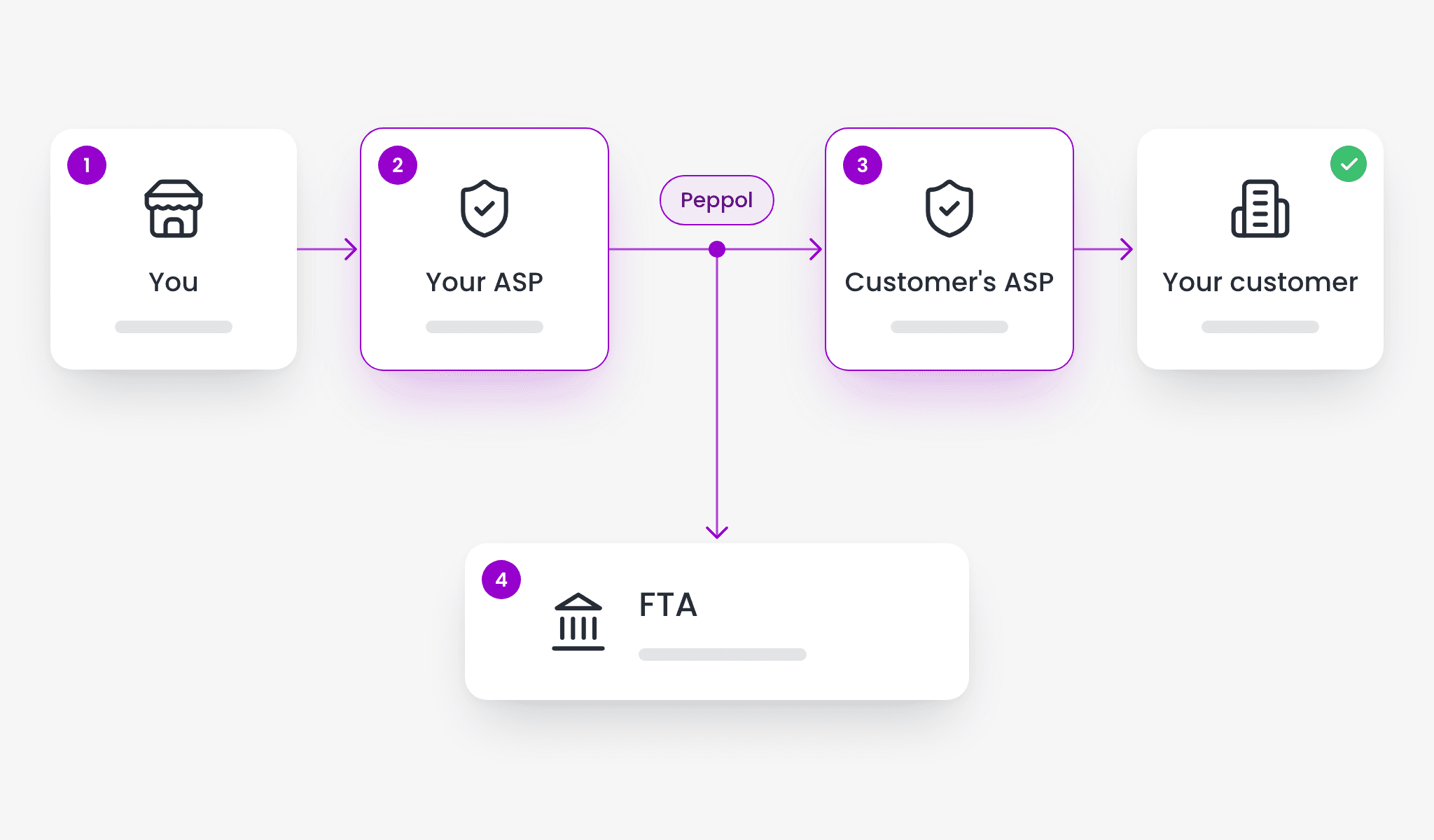
The Ministry of Finance calls it the "5-corner model". In simple terms, it's five steps:
- You create the invoice in your accounting or ERP software.
- Your ASP checks it. It makes sure every required detail is there, such as your customer's TRN. Anything missing is flagged before the invoice goes out.
- Your ASP sends it to your customer's ASP over the Peppol network.
- Your customer's ASP delivers it to your customer, either straight into their accounting software or through the ASP's online portal.
- The FTA receives the tax data. Both ASPs report it automatically, so you never upload anything yourself.
There's one catch: your software has to create the invoice in the right format and connect to an ASP. A basic billing app or an Excel sheet can't do that on its own.
Does This Apply to My Business?
If you sell to other businesses or to government in the UAE, it almost certainly does.
- Sales to businesses (B2B) and to government (B2G): included.
- Sales to walk-in customers and consumers (B2C): not included, for now.
- Not VAT registered? You're still included. VAT registration doesn't decide it.
- In a free zone? Your sales to businesses are still included.
There are a few special cases, and we go through common business types one by one in UAE E-Invoicing 2027: Is Your Business In or Out?
When Do I Need to Be Ready?
That depends on your annual revenue.
| Your annual revenue | Choose your ASP by | Start sending e-invoices |
|---|---|---|
| Under AED 50 million | 31 March 2027 | 1 July 2027 |
| AED 50 million or more | 30 October 2026 | 1 January 2027 |
You've probably seen "30 October" all over the news. Unless your business makes AED 50 million or more, that's not your date.
Missing your deadline can bring penalties. Every date, and how to plan for it, is in UAE E-Invoicing 2027: Key Dates and How to Plan Ahead.
A few special cases exist. If you're not sure whether they apply to you, WhatsApp us and we'll check.
Can I Still Send PDF Invoices?
This is the question we hear most. The honest answer is that it depends on when you send them and who you're selling to.
- Before your go-live date: yes. Keep invoicing the way you do now.
- After go-live, as an extra copy: yes. You can still send your customer a PDF for their records, as long as the e-invoice also goes through your ASP.
- After go-live, PDF only, to a business or government: no. Sending only a PDF means you haven't issued the e-invoice. That can bring penalties.
- To consumers (B2C): yes. PDF and paper invoices are fine for now.
There's another reason this matters. In its VAT Public Clarification VATP046 (September 2026), the FTA confirmed that when an e-invoice is required, the buyer must keep it in electronic format to claim back the VAT on it. A PDF copy on its own may not be enough. So once your customers are on the system, they'll start asking you for proper e-invoices
What Does This Look Like in Real Life?
Take a building materials trader in Sharjah. One morning, they deliver 200 bags of cement to a construction contractor. Both are businesses, so this sale is covered.
How it works today
- The salesman writes a delivery note by hand at the site.
- Back at the office, the accountant types it into the billing software.
- The software makes a PDF, and the office emails it.
- The contractor's accounts team types it into their own system.
- Weeks later, the contractor spots a wrong TRN, and the invoice is cancelled and reissued.
Three people typed the same invoice, and any one of them could have made a mistake.
How it works with e-invoicing
- Create it once. The invoice is made in the system, with the customer's TRN and item details already saved.
- It's checked before it goes. The ASP checks every required field. A missing TRN or a total that doesn't add up gets caught here, not weeks later.
- It's delivered digitally. It travels from the trader's ASP to the contractor's ASP and straight into the contractor's accounting software. Nobody retypes it.
- The FTA gets a copy automatically.
People often miss one thing: the contractor needs its own ASP too, to receive e-invoices. Every business uses one ASP for both sending and receiving.
The trader's work doesn't increase. If anything, it drops, because mistakes get caught at the start, when they're quick and cheap to fix.
Where Does Your Invoice Start?
Most e-invoicing guides skip this part. Sending the e-invoice is the easy bit, because your software and your ASP handle it.
The hard part comes earlier. Every e-invoice is built from your own records. If those records are messy, or if invoices are written on paper first and typed in later, the e-invoice will be rejected or wrong.
When we move businesses from Excel, paper or local software into RaadERP, we see the same problems again and again:
- Customers with no TRN on file, or a TRN with a missing digit.
- The same customer saved three times under slightly different names: "Al Noor Trading", "Al-Noor Trdg" and "AL NOOR LLC".
- Vague item names like "Cement bag" or "Misc material", with no unit or item code.
A PDF hides all of this. An e-invoice can't.
So where do your invoices start?
- In a van? Drivers who write bills on paper are your biggest risk. With RaadERP Van Sales, the driver makes the invoice on a phone or tablet at the customer's location, with prices, stock and the customer's TRN already there.
- On a construction site? Bills made in Excel and typed in later cause delays and mistakes. In RaadERP, invoices are created directly in the system, so nothing is typed twice.
- In a factory? Many factories write delivery notes by hand when goods go out, and days later the office types them into invoices. That causes delays and mistakes. In RaadERP, the delivery note is made in the system and the invoice is created from it in one click, so nothing is typed twice.
- At the office? You're in a better position, but your customer and item lists probably need cleaning. When you move to RaadERP, our team cleans them and imports them for you.
This is why RaadERP serves only four types of business: traders, manufacturers, van sales and contractors. When the invoice starts inside the system, e-invoicing is just the last step.
What Should I Do Now?
Nothing dramatic. Do just one thing this week: check the revenue in your latest financial statements, so you know which deadline is yours.
Not sure e-invoicing applies to you? Our guide UAE E-Invoicing 2027: Is Your Business In or Out? checks six real business types one by one, and a step-by-step checklist follows soon after.
Frequently Asked Questions
Is UAE e-invoicing mandatory for small businesses?
What is an ASP?
Do credit notes count too?
How long do I have to send an e-invoice?
Not Sure Where You Stand? WhatsApp Us
You don't need to work this out alone. Send us one message and we'll tell you:
- Your exact deadline
- Whether your current software can handle e-invoicing
- The one thing to fix first in your business
You'll get a straight answer from people who set up businesses on RaadERP, with no sales script.
WhatsApp "E-INVOICE" to +971545437817 and we'll reply quickly.
Source: UAE Ministry of Finance: Ministerial Decisions No. 243 and 244 of 2025, No. 66 and 197 of 2026; UAE Electronic Invoicing Guidelines v1.1; FTA Public Clarification VATP046. mof.gov.ae/einvoicing
RaadERP is built for UAE traders, manufacturers, van sales and contracting businesses. It covers invoicing, inventory, accounts and e-invoicing in one system.
This article is general information only and is not legal, tax or professional advice. Regulations, including ZATCA, UAE Ministry of Finance and FTA requirements, change often, and this content may be incomplete, out of date or contain errors. Before you act on it, check with the official authority (ZATCA in Saudi Arabia, or the Ministry of Finance or Federal Tax Authority in the UAE) or a qualified tax adviser. Raad ERP makes no warranties about the accuracy or completeness of this content and accepts no liability for any loss arising from reliance on it. Links to third-party websites are provided for convenience and are not endorsements.