

Last updated: 28 October 2026. Based on UAE Ministry of Finance and FTA rules in force on this date. We update this page whenever the rules change.
The Short Version
Most UAE businesses only need to plan for two e-invoicing dates. Here's what they are, and how to get ready without a last-minute rush.
Both are closer than they look, so it pays to start early.
- Under AED 50 million revenue: appoint your accredited service provider (ASP) by 31 March 2027, and start sending e-invoices on 1 July 2027.
- AED 50 million or more: appoint your ASP by 30 October 2026, and start sending e-invoices on 1 January 2027.
- Our advice for businesses under AED 50 million: have your provider in place by mid-February 2027, about six weeks before the official deadline.
Your Deadlines If Revenue Is Under AED 50 Million
| Date | What happens |
|---|---|
| 31 March 2027 | Appoint an ASP |
| 1 July 2027 | Start issuing e-invoices |
Other Dates
| Date | What happens | Who it applies to |
|---|---|---|
| 1 July 2026 | The voluntary phase opened. Any business can join early, with no penalties | Anyone |
| 30 October 2026 | Appoint an ASP | Revenue AED 50 million or more |
| 1 January 2027 | Start issuing e-invoices | Revenue AED 50 million or more |
| 31 March 2027 | Appoint an ASP | Government entities |
| 1 October 2027 | Start issuing e-invoices | Government entities |
| 31 December 2028 | Relief for invoices between VAT group members ends | VAT groups |
What About 30 October?
You've probably seen 30 October 2026 in the news. That date is real, but it's for one particular group: businesses with revenue of AED 50 million or more.
The deadline for those businesses to appoint their ASP is 30 October 2026, and they start sending e-invoices on 1 January 2027. The date was originally 31 July 2026. The Ministry of Finance moved it to 30 October.
If your revenue is under AED 50 million, you're in the second group, and your dates come later.
31 March 2027: Pick Your Provider
There's more to this date than paperwork. By 31 March, you need to have:
- Chosen an ASP from the Ministry of Finance's approved list.
- Signed an agreement with that provider.
- Appointed them on EmaraTax, the FTA's portal, through its e-invoicing section.
- Registered for a tax ID number (TIN) on EmaraTax, if you're not VAT registered and don't have one yet.
- Got set up to receive e-invoices. Once your provider is in place, suppliers who are already live can start sending to you.
Many people miss that last point. E-invoicing isn't only about sending, so be ready to receive too.
It's also worth knowing that appointing a provider on EmaraTax doesn't finish the job. It starts the technical setup, and that takes time.
1 July 2027: Start Sending E-Invoices
From 1 July:
- Every invoice and credit note for a sale to a business or government goes out as an e-invoice.
- It travels through your ASP, and the FTA receives a copy.
- A PDF on its own no longer counts as a valid invoice for sales to businesses or government. You can still send your customer a PDF copy for their records, but the e-invoice sent through your ASP is the official one.
If you set everything up properly by 31 March, going live on 1 July is easy: you simply start sending. If you rush the setup, the problems show up in July, when your real invoices start getting rejected.
What Happens Between Now and July?
Your deadline is months away, but the system starts moving around you much sooner.
January 2027: your big suppliers go first. Large companies start sending e-invoices on 1 January, and that probably includes some of your suppliers: the steel mill, the big FMCG distributor, the cement company. Until you're set up, they report their invoices to the FTA through a fixed government address and give you a normal invoice. You may not notice any difference yet.
By 31 March 2027: you join the network. Once your provider is in place, which we'd recommend by mid-February, those suppliers' e-invoices start reaching you through it. Your purchase invoices arrive as data, not as PDFs in your inbox.
April to June 2027: the quiet window. You're connected but not yet required to send. Any business can send e-invoices voluntarily, and penalties only apply from your mandatory date.
1 July 2027: you go live. Your sales invoices to businesses now go out as e-invoices.
So for a few months, you may receive e-invoices before you have to send them. Use that time well:
- Learn from your suppliers' e-invoices. See what a real one looks like, and check that it lands correctly in your purchases.
- Send a few e-invoices voluntarily. Pick two or three friendly customers. If one is rejected for a missing TRN or a wrong item code, you fix it with no fine.
- Train your team on real invoices, not a demo.
Raad ERP's Advice: Plan for February, Not 31 March
Officially you have until 31 March. In practice, we'd treat mid-February as your real deadline, for three reasons:
- Ramadan falls right before the deadline. It's expected to begin on 8 February 2027 and run until early March. Working hours get shorter, decisions slow down, and Eid comes just weeks before 31 March.
- Almost everyone shares your date. Every business under AED 50 million has the same deadline, and that's most businesses in the UAE. Providers, software companies and accountants will all be busiest in March.
- Appointing is the start, not the finish. After you appoint a provider, your system still has to be connected, tested and checked against your real invoices.
Anyone who ran a business here when VAT arrived in 2018 remembers the last-minute rush.
Working back from July, it looks like this:
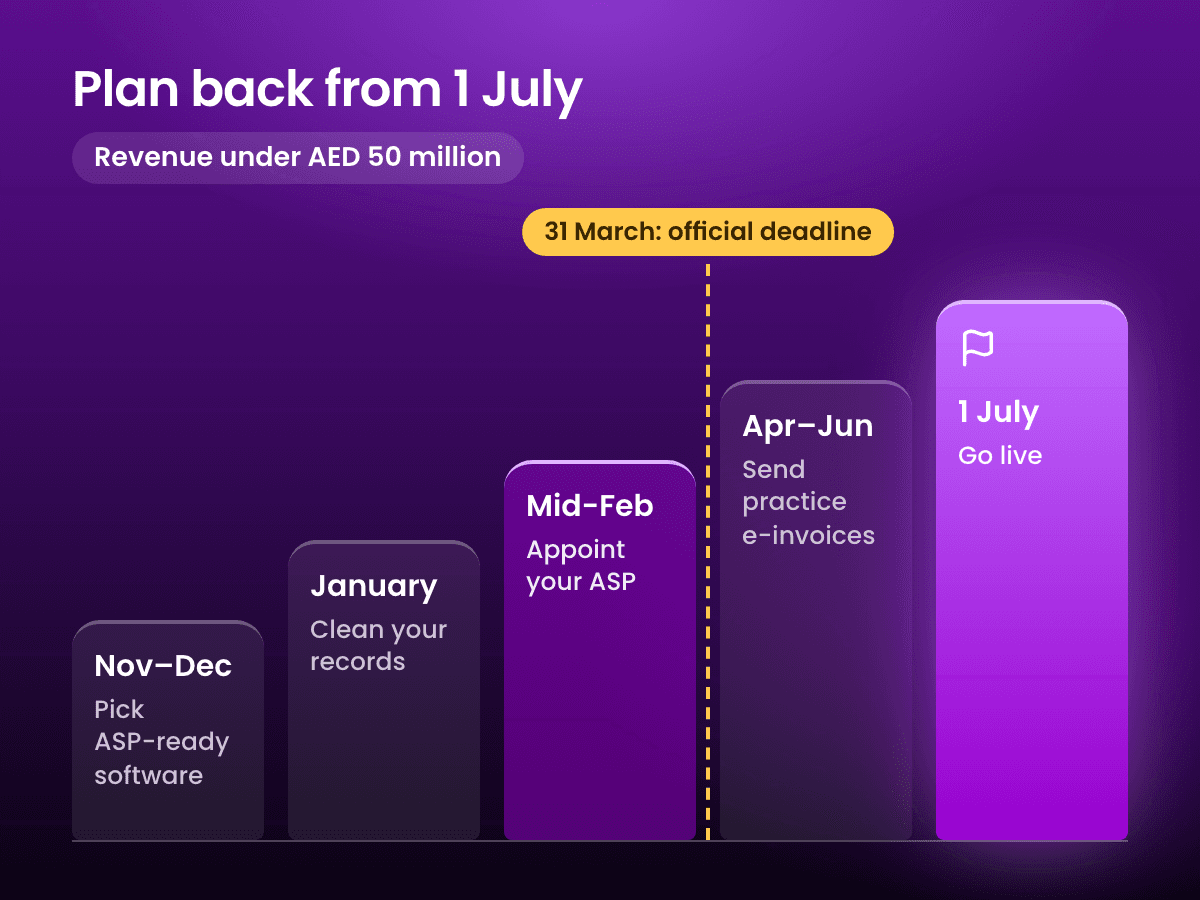
| When | What to focus on |
|---|---|
| November to December 2026 | Choose ASP-ready software. Check whether your current software can create e-invoices and connect to an ASP. If it can't, pick one that can. Every later step depends on this choice |
| January 2027 | Clean your customer and item records. Register for a TIN if you need one |
| By mid-February 2027 | Appoint the ASP your software works with on EmaraTax |
| April to June 2027 | Send practice e-invoices and train your team |
| 1 July 2027 | Go live |
Take it one step at a time. We'll turn this into a step-by-step checklist in an upcoming post.
The same applies to us. The Raad ERP team sets up a limited number of businesses each month, so March slots will fill fast. Starting in November or December gives you more time for your data, your setup and your team's training.
Will the Deadline Move Again?
We wouldn't count on it.
The one extension so far was narrow. Only the provider date for large businesses moved, from July to October 2026, and their go-live date of 1 January 2027 didn't change.
So plan with the dates you have. If they ever move, you'll simply be early, and being early has never cost anyone a fine.
What missing it costs: penalties for being late to appoint a provider or set up the system, and for e-invoices not issued correctly once you're live.
Are There Any Other UAE E-Invoicing Dates to Know?
A few dates sit beyond July 2027. Most won't affect you, but it's good to know they exist.
- 1 October 2027: government goes live. Government entities start sending e-invoices. If you supply government, your sales to them are e-invoices from July. Until government entities go live in October, your ASP sends those invoices to a fixed government address, and you give them a normal copy as you do today.
- 31 December 2028: VAT group relief ends. Invoices between companies in the same VAT group don't need e-invoicing until then. From 2029, they do.
- B2C: no date yet. Sales to consumers are outside the system for now. The Ministry will announce it if that changes, and we'll update this page when it does.
Frequently Asked Questions
What is the UAE e-invoicing deadline for small businesses?
Which year's revenue decides my phase?
Can I appoint my provider before 31 March?
Can I start e-invoicing before 1 July 2027?
What if I miss 31 March by a few days?
Not Sure Which Date Is Yours? WhatsApp Us
Tell us roughly what your business does and how big it is. We'll tell you:
- Which phase you're in
- Your exact two dates
- Whether you can realistically be ready by mid-February
WhatsApp "DATES" to +971 54 543 7817 and we'll reply quickly.
New to e-invoicing? Start with UAE E-Invoicing 2027 Made Simple: Rules & What Changes. Not sure it applies to you? Read UAE E-Invoicing 2027: Is Your Business In or Out?
Source: UAE Ministry of Finance: Ministerial Decisions No. 243 and 244 of 2025, No. 66 and 197 of 2026; UAE Electronic Invoicing Guidelines v1.1; FTA Public Clarification VATP046. mof.gov.ae/einvoicing
Raad ERP is built for UAE traders, manufacturers, van sales and contracting businesses. It covers invoicing, inventory, accounts and e-invoicing in one system.
This article is general information only and is not legal, tax or professional advice. Regulations, including ZATCA, UAE Ministry of Finance and FTA requirements, change often, and this content may be incomplete, out of date or contain errors. Before you act on it, check with the official authority (ZATCA in Saudi Arabia, or the Ministry of Finance or Federal Tax Authority in the UAE) or a qualified tax adviser. Raad ERP makes no warranties about the accuracy or completeness of this content and accepts no liability for any loss arising from reliance on it. Links to third-party websites are provided for convenience and are not endorsements.